
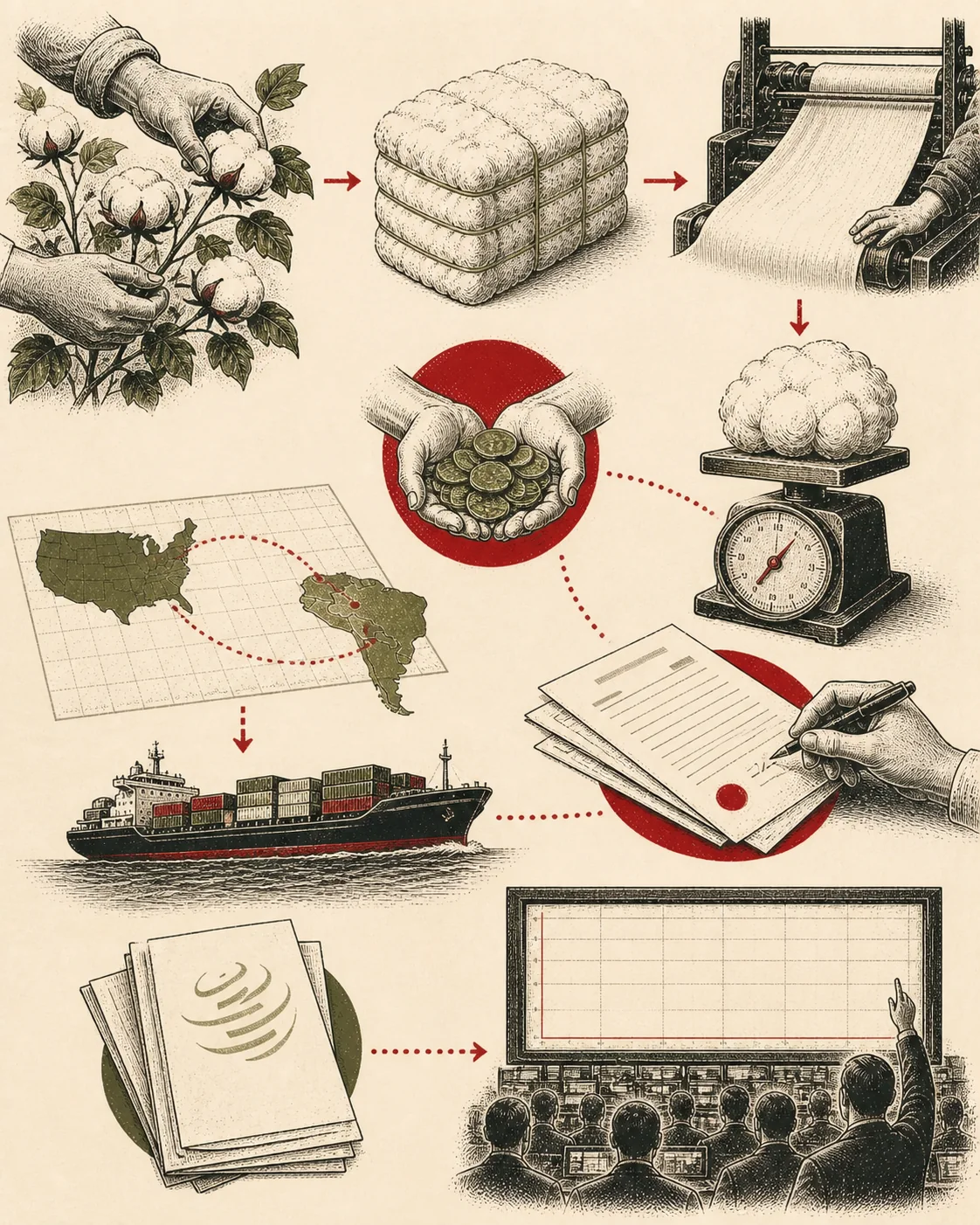
Case DS267 at the World Trade Organization runs to hundreds of pages, but its opening line is simple: on 27 September 2002, Brazil asked the WTO to convene a panel because United States payments to its own cotton farmers were, in Brazil’s filing, suppressing the world price of cotton that Brazilian farmers had to sell into. The panel agreed, in a ruling issued 8 September 2004. The WTO’s Appellate Body upheld the core of that ruling on 3 March 2005. It is the most consequential piece of paper in modern cotton pricing, and almost nobody who buys a cotton shirt has heard of it.
Ask where the price of cotton comes from and the reflexive answer is demand: more shirts wanted, more cotton wanted, price goes up. Demand matters, but it explains the wiggle around a line, not the position of the line itself. For the last quarter century, that line has been set as much by a dispute between two governments as by anyone buying a t-shirt.
What Brazil actually proved
Brazil’s case targeted three kinds of US support: marketing loan payments and counter-cyclical payments that rose automatically when the market price fell, so-called Step 2 payments that subsidized US mills and exporters for buying US cotton over cheaper imports, and export credit guarantee programs, GSM 102 and GSM 103 among them, that backed loans to foreign buyers of American cotton. The panel found the guarantee programs were themselves a form of prohibited export subsidy, since the fees the government charged for them did not cover its own long-run costs. It found separately that the price-contingent payments caused what WTO law calls “serious prejudice,” meaning they measurably suppressed the world price Brazilian and other producers could get.
The United States revised some programs and told the WTO it had complied. Congress repealed the Step 2 program outright through the Deficit Reduction Omnibus Reconciliation Act of 2005, effective 1 August 2006, according to the US Trade Representative’s own announcement of the repeal, which named the Brazil ruling as the reason. Brazil did not consider that sufficient, and a compliance panel took up the question of the remaining programs. On 18 December 2007, that panel ruled the United States still had not removed the price-suppressing effect of its marketing loan and counter-cyclical payments. A WTO arbitration panel set the retaliation figure in August 2009: $147.3 million tied directly to the actionable subsidies, plus a variable amount pegged to US export credit spending each year. Using 2008 program data, Brazil worked that formula out to $829.3 million in goods it could hit with tariffs, including $268.3 million it was cleared to take out in cross-retaliation against US patents, copyrights, and services rather than goods alone, an unusual remedy the WTO had never before authorized in a subsidy case.
Brazil never imposed the full countermeasures. Negotiators reached a preliminary deal on 6 April 2010, the day before Brazil’s retaliation window opened, and concluded a Framework for a Mutually Agreed Solution on 17 June 2010, which the WTO’s own case record dates as formally signed 25 August 2010. Under it, the United States agreed to pay $12.275 million a month, $147.3 million a year, into a technical assistance fund for Brazil’s cotton sector, administered through the Brazilian Cotton Institute, and to consult with Brazil before making further changes to its farm programs. Brazil suspended its authorized retaliation while both sides worked out a permanent fix under the next US farm bill. That fix took another four years to finalize. On 16 October 2014, Brazil and the United States signed a memorandum of understanding closing the case outright, twelve years after Brazil’s original filing, and the technical assistance payments stopped with it.
The subsidy structure the case was fought over, and what replaced it
The 2014 farm bill restructured the programs the WTO had objected to, folding cotton support into new shapes with new names: Price Loss Coverage and Agriculture Risk Coverage, alongside the older marketing assistance loan. PLC pays a farmer when the national average market price falls below a statutory reference price, with the payment equal to that gap multiplied by 85 percent of the farm’s base acres. ARC-County pays when a county’s crop revenue falls below 90 percent of a five-year rolling average of its own recent history, with the highest and lowest years dropped from the average first. Neither is styled as an export subsidy, which was the specific WTO violation; both still put a government floor under what a US cotton farm can expect to earn regardless of what the world market does.
That floor moved again this year. The One Big Beautiful Bill Act, signed into law in July 2025, raised the seed cotton reference price used for PLC payments from 36.7 cents a pound to 42 cents, and set the upland cotton marketing assistance loan rate at 55 cents a pound, according to USDA’s Economic Research Service. Both figures run through the 2031 crop year. For 2025 alone, the law let farmers take whichever of PLC or ARC paid more, without having to enroll in one program and forgo the other, an unusual concession that USDA’s own summary treats as a one-year exception rather than the new normal.
None of this is illegal under the 2014 settlement, which resolved Brazil’s specific complaint rather than banning US farm support outright. It does mean the reference price a US cotton farmer is guaranteed against is a number set in a reconciliation bill in Washington, not a number discovered on a trading floor.
What the futures contract actually is
The trading floor, for what it is worth, is real and specific. Cotton No. 2 futures trade on ICE Futures US under the ticker CT. One contract covers 50,000 pounds of cotton, roughly 100 bales, meeting a minimum basis grade and staple length set by the exchange. The smallest price move allowed is one hundredth of a cent per pound, worth five dollars a contract. Delivery months run March, May, July, October, and December, and a trader who holds a contract to expiration can be required to take or make delivery at one of five approved US points: Galveston, Houston, Dallas-Fort Worth, Memphis, or Greenville-Spartanburg.
That contract is where weather and demand actually show up in the price. The December 2026 contract settled at 84.8 cents a pound on Friday, August 17, 2026, up more than a cent on the session, a move market reporting that day attributed to a weaker dollar, rising energy prices, and export sales running ahead of USDA’s own projections for the 2025-26 marketing year. That is the demand side of the story, and it is real. It sits on top of a floor that Washington, not the exchange, put there.
Why this matters more than it looks like it should
Subsidies are not the whole price. A bad harvest in Texas or a strong export season moves the number on the ICE ticker every week, sometimes by more than a subsidy program does in a year. The narrower and harder claim to argue with is this: the floor under that number, the price a US cotton farmer can plan around no matter what the ticker says, is a policy choice renewed in 2025 and litigated for twelve years before that. A fiber that gets discussed as a weather story and a fashion story is also, underneath both, a trade-law story with a case number.
DRESS garments are cut and sewn in the United States on fabric chosen for weight rather than the cheapest bale available that week, which does not exempt the fabric from any of this. It is still cotton, still priced against a floor a reconciliation bill set in July 2025, still traded fifty thousand pounds at a time on a contract written before most of the people wearing it were born.