
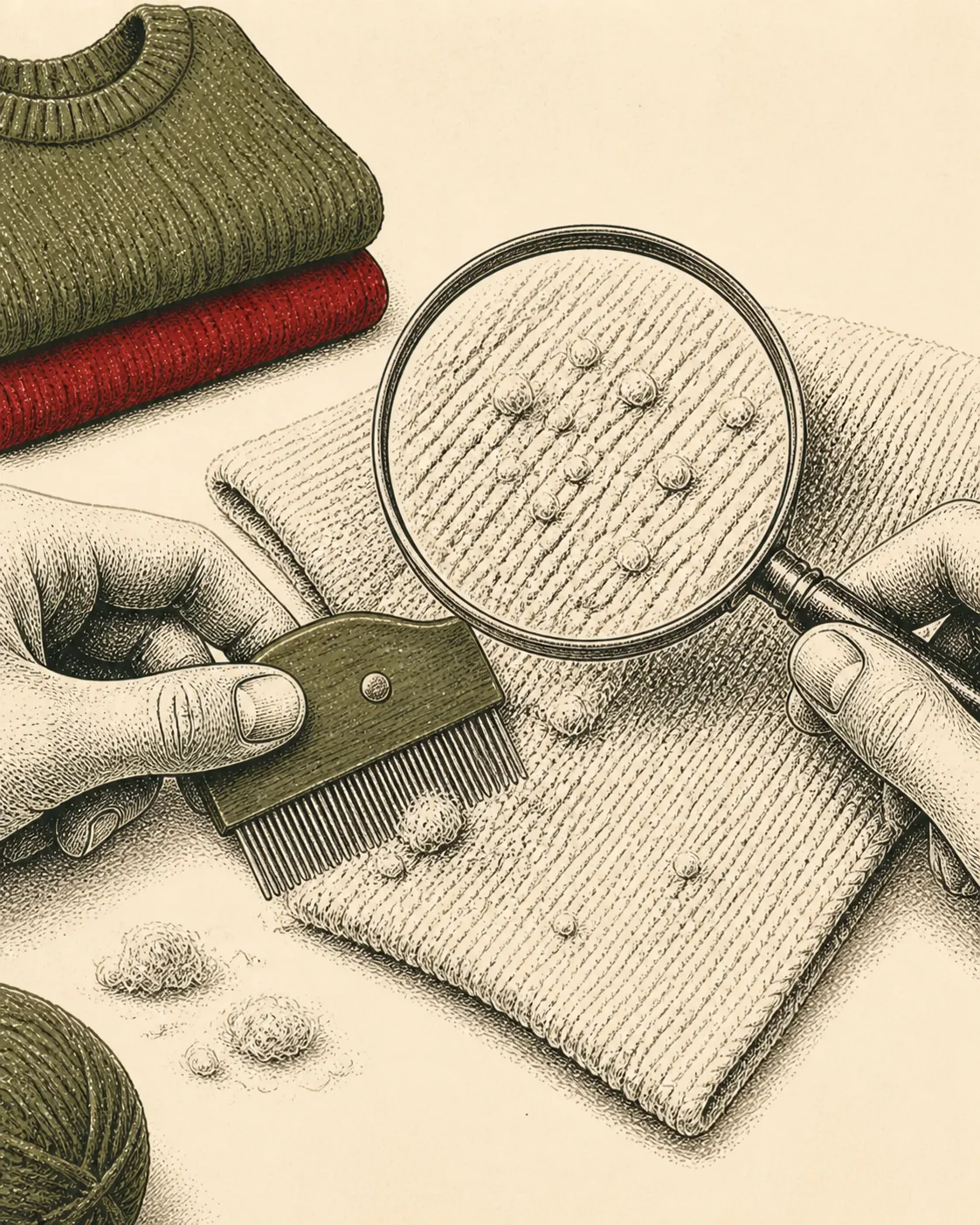
Pull a sweater out of the drawer in October and there they are: small gray balls scattered across the sleeve, worst at the cuff and the spot where a bag strap sits all day. They are your sweater, leaving, one snagged fiber at a time, closer to shed hair than a manufacturing flaw. Whether they fall back off or ride along for the rest of the garment’s life comes down to a property most people never think about: how strong the fiber is.
What a pill actually is
Textile researchers describe pilling as a staged process, not a single event. Friction, mostly at contact points like underarms, cuffs, and collars, works loose fiber ends out of the yarn structure and up to the fabric surface. That loose layer is fuzz. Keep rubbing and the fuzz twists on itself, the way a stray thread wraps around your finger, until it compacts into a small tangled mass. Joanna Sekulska-Nalewajko and colleagues, writing in Sensors in 2020, describe the sequence this way, citing the earlier work of Gintis and Mead: fibers are drawn to the surface as fuzz, “the fuzz then becomes entangled into pills.” A ball has now formed. What happens to it next is the part that actually decides whether your garment looks pilled six months from now.
Why some pills fall off and others don’t
A pill does not float free. It stays connected to the fabric by a handful of fibers that never fully worked loose, threads still rooted in the yarn while the rest of the tangle sits on top. Sekulska-Nalewajko’s paper, drawing on the researcher Cooke, describes the pill as “anchored to the fabric by a few unbroken fibers,” fibers that get pulled and fatigued by continued abrasion until they either snap or pull free entirely. That last step, the one that determines whether the pill goes away, comes down to a straightforward mechanical fact: how much force the anchor fiber can take before it breaks.
This is where synthetic fiber and cotton part ways, and a 1987 patent filed by Celanese states the mechanism about as plainly as an industrial document gets. Describing why polyester fabric holds onto its pills, the patent explains that pill retention “can be traced to the relatively high strength of the synthetic fibers present in the fabric,” fibers strong enough that the pill stays “permanently attached to the fabric’s surface” because the anchor threads “resist breakage” under the same abrasion that would snap a weaker fiber. Cotton gets the opposite fate in the same document: entangled cotton fibers “readily break away since the cotton fibers are of an inherently lesser strength.” Same friction, same tangling, same anchoring mechanism. The only variable is whether the anchor thread can survive being pulled on. Polyester can. Cotton, fiber for fiber, generally can’t.
That asymmetry is behind the folk wisdom that a cotton tee wears out but a poly blend pills forever. Cotton does not resist pilling any better than polyester does; both fabrics form pills under the same conditions. Cotton just keeps shedding them, so the surface never accumulates the buildup that reads as pilled, while a shirt with real polyester content, even 10 or 20 percent in a blend, holds on to every ball it grows.
Spinning and combing change the starting odds
Fiber chemistry sets the ceiling, but how the yarn was made decides how much fuzz shows up to begin with. Combing is a mechanical step that pulls the shortest fibers out of raw cotton before it’s spun, the fibers most likely to have one end anchored and one end loose enough to migrate to the surface under friction. A combed, ring-spun yarn starts with fewer of those loose ends than an uncombed, open-end yarn spun from the same bale, which is a mechanical reason, not a marketing one, that combed ring-spun cotton reads as smoother and pills less in the first few washes. It does not change what happens once a pill does form; a combed cotton tee still sheds its pills the way any cotton fabric does. It just produces less fuzz for the process to work on.
How the industry actually measures it
Pilling isn’t judged by eye alone, or wasn’t meant to be. ASTM D3512 puts a fabric swatch into a cork-lined drum with rotating paddles and a handful of loose cotton fiber, tumbles it for a set number of revolutions, then a technician rates the surface on a five-point scale: 5 for no pilling down to 1 for very severe pilling, with half-point grades allowed in between. ISO 12945-2 gets at the same question with a different motion, rubbing the fabric against itself or a standard abrasive on a Martindale machine rather than tumbling it. Neither test predicts your exact sweater’s fate. A drum and a mill sample can’t reproduce a bag strap crossing the same six square inches of shoulder every day for a year. What the grade tells a buyer is comparative: this fabric, under controlled abrasion, held on to more or fewer pills than that one, which is the number mills actually put on a spec sheet.
What to do with a pill, once it’s there
You can shave one off with a fabric comb or a battery razor built for the job, and plenty of people do, but the anchor fiber is still there underneath, ready to catch the next tangle. The more durable fix is reducing the friction that starts the process in the first place: wash a fleece or a poly blend inside out, wash it separate from denim and anything with a rough zipper, and skip a hot tumble dry when the label allows it, since the dryer’s mechanical action is itself a pilling test running on your actual clothes. None of that changes the fiber. A garment with real polyester in it will pill less under gentler handling. It will not stop.
The gray ball on a sleeve, then, is not evidence of a cheap shirt or a dirty one. It’s a strength test the fabric has been running on itself since the day it left the mill, and the fiber under the surface already decided how it ends.