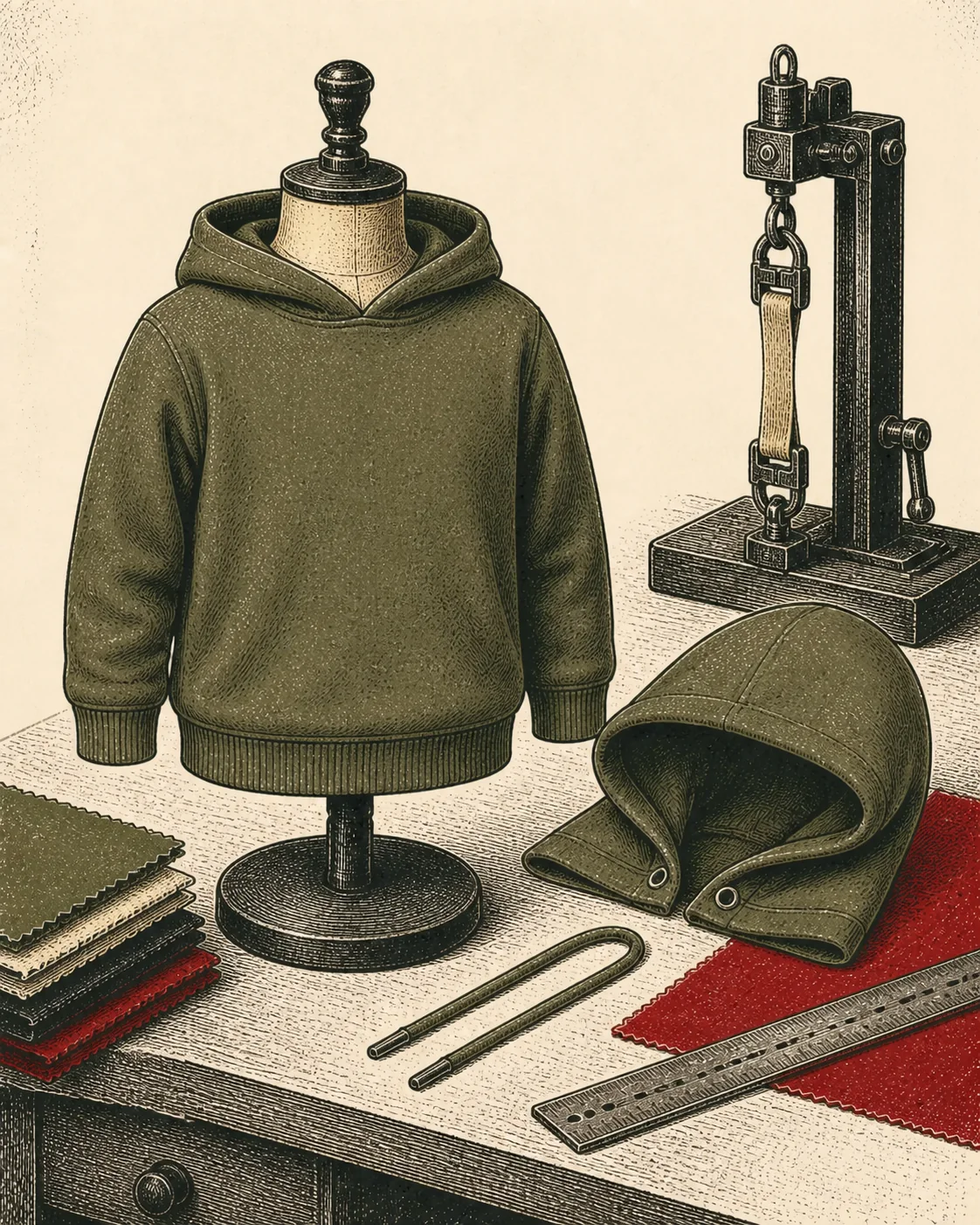
A child’s hood used to close the way an adult’s still does: a cord run through a channel, two plastic aglets hanging free, pull it snug against the wind. That cord caught on playground rails, school bus doors, and car seats often enough, and tightened often enough, that the federal government eventually wrote a rule to remove it from children’s clothing entirely. The hood on a kids’ sweatshirt today is cordless, or held shut with elastic, snaps, or a fabric tab that can’t cinch down on anything, and the reason sits in a Consumer Product Safety Commission file, not a design trend.
The number the rule is built on
The Commission’s final rule, published in the Federal Register on July 19, 2011, lays out its own count: from January 1985 through April 2011, CPSC staff identified 56 incidents involving the neck or hood drawstring on children’s upper outerwear. Eighteen of those were fatal. Thirty were nonfatal injuries, and eight involved no injury at all, just a cord caught on something with a child still attached to it. A separate count for waist and bottom drawstrings over the same span logged 28 incidents, 8 of them fatal, all eight of those deaths clustered between 1991 and 1996.
The before-and-after in that same document is the clearest part of the record. In the twelve years before any standard existed, 1985 through 1996, the Commission counted 12 deaths and 33 nonfatal entanglements tied to neck and hood drawstrings. In the eight years after industry adopted a voluntary standard, 1999 through 2006, that fell to 2 deaths and 2 nonfatal incidents. The mechanism did not change. Kids still climb slides, still ride buses, still get their clothing caught on car seats and playground equipment. What changed was whether the hood had a cord to catch on any of it.
From a warning to a standard to a law
The Commission did not start with a rule. In February 1996 it issued voluntary guidelines, addressed to consumers, manufacturers, and retailers, recommending that drawstrings be removed from the hood and neck of children’s upper outerwear entirely. A guideline carries no legal force; it tells an industry what the Commission already knows and leaves the response to reputation, press coverage, and a manufacturer’s own sense of liability.
The industry did act, largely. ASTM International, the standards body that turns industry practice into a document a compliance department can cite, approved ASTM F1816-97 in June 1997 and published it in August 1998. The standard did two different things depending on where the drawstring sat. At the hood and neck, on sizes 2T to 12, it prohibited drawstrings outright. At the waist and bottom, on sizes 2T to 16, it did not prohibit the cord; it limited it: no more than 3 inches of free length outside the drawstring channel when the garment is pulled to its fullest width, no toggles, no knots, and if the cord is one continuous piece it has to be bar tacked, stitched through, so it can’t be pulled entirely free of its channel and turned into a loop.
A voluntary standard is only as strong as a manufacturer’s willingness to follow it, and enforcement of a voluntary standard is limited to persuasion and bad publicity. The Commission spent the 2000s watching drawstring incidents continue at retailers who had not adopted F1816-97, and in 2011 it closed that gap. On July 19, 2011, the Commission published a determination that children’s upper outerwear failing to meet F1816-97’s neck, hood, waist, and bottom drawstring provisions constitutes a substantial product hazard under federal consumer product safety law. The rule, now codified at 16 CFR Part 1120, took effect August 18, 2011. A garment that fails it becomes recallable, in the same legal category as a defective car seat or a toy coated in lead paint, not merely a garment out of step with an industry norm that nobody has to answer for.
What the rule actually covers
The size ranges matter because they mark where the Commission drew the line between a child who cannot free a caught cord and a child, or an adult, who generally can. Neck and hood drawstrings are prohibited on sizes 2T to 12. Waist and bottom drawstrings are allowed but constrained on sizes 2T to 16, the wider range reflecting that a cord at the waist is a snagging hazard rather than a strangulation one, and older kids can usually manage it. Above size 12 or 16, depending on the location, the rule stops applying. An adult hoodie can still ship with a hood drawcord because an adult, in the Commission’s own analysis, is not the population these incidents were happening to.
None of this touched adult garments, and it was never meant to. The hazard the Commission was tracking is specific to how a young child interacts with playground equipment, bus doors, and car seats, and to how much force and time a young child has to free themselves before a caught cord becomes a strangulation. An adult wearing a hoodie with a drawcord at a bus stop is not the population 16 CFR Part 1120 exists to protect.
The rule also did not reach every drawstring on a children’s garment, only the ones tied to a documented pattern of harm. Waist and bottom cords stayed legal because the injury pattern behind them was different in kind: snags and falls rather than strangulations, concentrated in the years before 1997 and essentially absent afterward. That is a narrower fix than banning drawstrings on kidswear outright, and it is the kind of narrow fix a rule built on incident data tends to produce. The Commission did not decide cords were dangerous in the abstract. It decided a cord in one specific location, on one specific range of bodies, had killed a measurable number of children, and wrote a rule that removed exactly that.
Where that leaves a hood today
Walk a children’s department now and the hoods either have no cord at all, close with elastic sewn into the channel, or use a short fabric tab with a snap. None of it looks like an accident of fashion. It is what happens when a federal agency counts eighteen deaths, traces every one of them to the same three inches of cord, and writes a rule that removes the cord instead of asking parents to watch more carefully. Our own hoodie carries a tonal drawcord at the hood because it is cut for adults, sized S through 2XL, outside the range 16 CFR Part 1120 governs. The rule that emptied a children’s hood is the reason an adult one can still have one.