
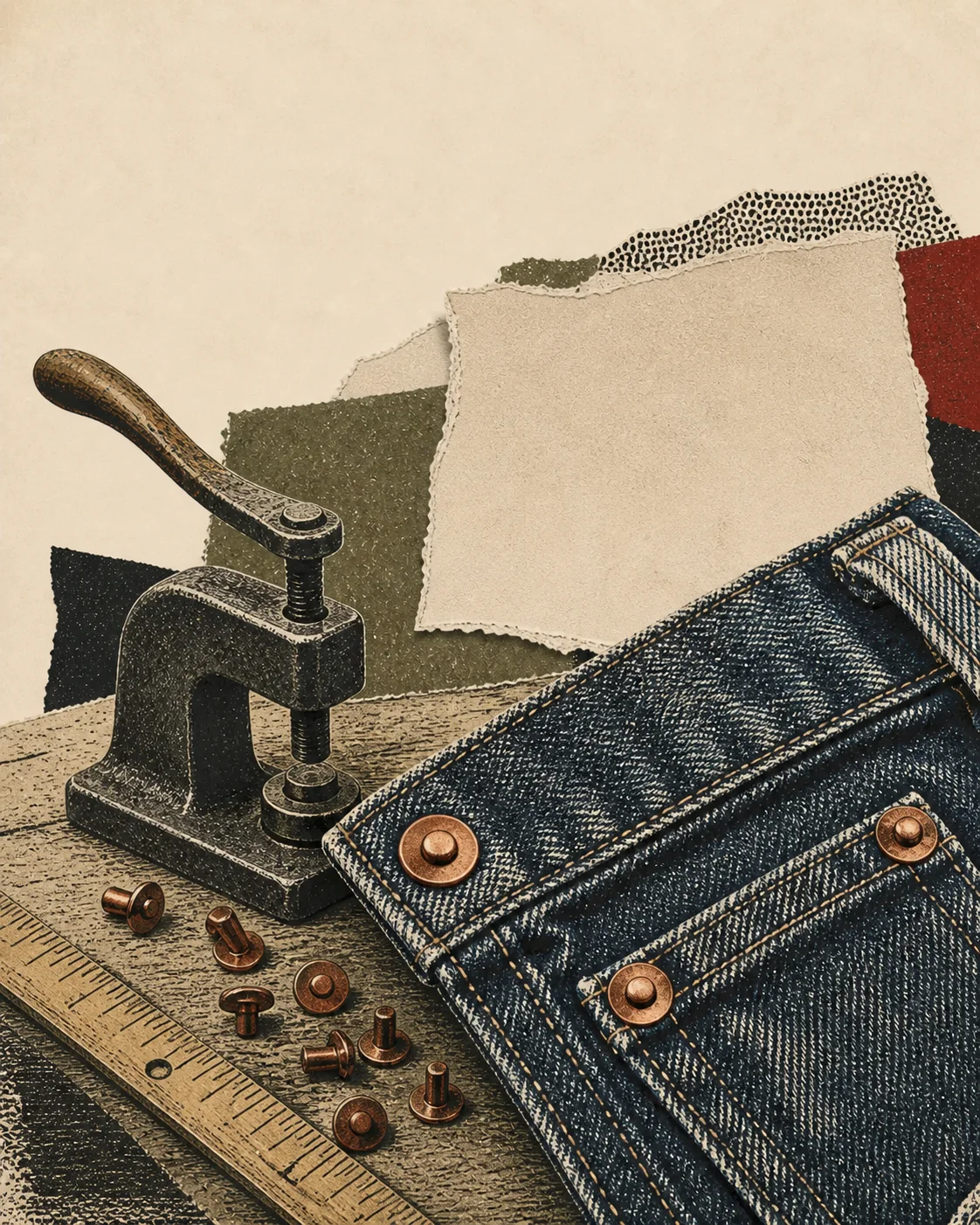
In January 1871, a woman walked into Jacob Davis’s tailor shop on Virginia Street in Reno, Nevada, and put down three dollars. She wanted a pair of pants for her husband, a laborer who went through work pants fast, and she asked Davis to make them as strong as he could. Davis was already riveting horse blankets and wagon covers for the railroad crews building through Reno. He had copper rivets sitting on his worktable. He used them on the pocket corners of the pants, the spot where a man’s hand, a hammer, or a fistful of tools tore the seam out first.
The specific failure the patent solves
Davis was not solving durability in the abstract. He was solving one seam. Pocket openings on work pants ripped out because every time a hand went into a full pocket, the strain landed on the thread holding the corner together, and thread loses that fight. His fix, later written into US Patent 139,121, was to drive a metal rivet through both layers of cloth at each edge of the pocket opening and hammer it flat on both sides. The patent’s own language is plain about what the rivet is for:
“I pass through a hole at the end of the seam, so as to bind the two parts of cloth together, and then head it down upon both sides so as to firmly unite the two parts, and prevent the strain or pressure from coming upon the thread with which the seam is sewed.”
The rivet does not reinforce the thread. It replaces the thread as the part that takes the load. That distinction is why the patent is titled “Improvement in Fastening Pocket-Openings” rather than anything about denim, jeans, or workwear generally. The claim covers “the employment of a metal rivet or eyelet at each edge of the pocket opening” and says nothing about the fabric underneath it, because the fabric was never the problem. Davis filed the application on August 9, 1872, and the US Patent and Trademark Office granted it on May 20, 1873, to Jacob W. Davis of Reno, with the rights assigned jointly to himself and to Levi Strauss & Co. of San Francisco.
A tailor who could not afford his own idea
Davis was not a young man chasing a first invention. He was born in Riga, in what is now Latvia, in 1831, trained as a tailor there, and left for the United States in his early twenties. He worked the trade across the country, from New York to San Francisco, tried and lost money on a brewery, and finally settled in Reno in June 1868, opening his tailoring shop the following year. By the time the rivet idea came to him, he had also patented a screw-fastened button and a design for a tailor’s pressing board. Riveting a pocket was one more practical fix from a man who fixed things for a living, not a single flash of inspiration from nowhere.
Davis had been buying his denim and duck cloth from Levi Strauss & Co. for a couple of years by the time he riveted that pair of pants. He knew the rivets worked. What he did not have was the patent filing fee, a cost some later company retrospectives put around $68, a real sum for a tailor running one shop in a railroad town. So he wrote to Strauss in San Francisco in 1872 with a proposal: Strauss pays to file the patent, and the two of them hold it together, splitting the right to make and sell riveted clothing under it.
Strauss said yes. It is the reason the most famous name in denim is not the name on the invention. Davis drew the improvement and swore the deposition describing how he came to it; Strauss put up the money and the manufacturing scale to turn one tailor’s fix into a garment sold nationally. When the patent issued in 1873, Davis sold his Reno property, moved his family to San Francisco, and went to work supervising the factory floor that made his own invention, eventually overseeing hundreds of employees there until his death in 1908.
The patent itself did not stay narrow for long. In 1875, Davis and Strauss secured a reissue, US RE 6,335, widening the claim from “pantaloons” specifically to riveted pocket openings and seams on garments generally. A wider claim was worth defending, and Davis and Strauss spent the following years doing exactly that, filing infringement suits against other makers who copied the rivet without a license. Patents of that era ran roughly seventeen years, and by about 1890 the original protection had lapsed. Once it did, any manufacturer could rivet a pocket without paying anyone, and Levi Strauss & Co. dropped the patent date it had stamped on its rivets since the invention was new.
The rivet that scratched the furniture
Rivets stayed on the outside of the back pockets for decades after that, doing on a store shelf exactly what they were built to do on a worksite: hold the corner. The trouble was everywhere else those pants ended up. A rivet sitting proud of the fabric on the back pocket will mark up a wooden chair, a saddle, and eventually a car seat, and Levi Strauss & Co. heard about it from customers for years.
In 1937, the company’s answer was not to remove the rivets but to hide them. It patented a new construction, US Patent 1,999,927, that covered the exposed back-pocket rivets with a layer of fabric so the metal no longer touched whatever the wearer sat on. That held for about three decades. The covered rivets kept working loose against the denim from the inside, wearing through the fabric that hid them and exposing the same metal edge that had started the complaints in the first place. By 1966, Levi Strauss & Co. gave up on covering the rivet and removed it from the back pocket outright, replacing it with a bar-tack, a dense zigzag of reinforcing stitches sewn directly into the corner.
The front pockets and the base of the fly kept their rivets. Those never touched a chair seat, and the failure Davis fixed in 1871, a seam splitting under a hand or a tool, was still a front-pocket problem, not a back-pocket one. Ninety-five years after a Reno tailor ran out of money to protect his own idea, the garment had sorted his invention into the place it still belonged and the place it did not, without a word said about either.
Run a thumb along the back pocket corner of a pair of jeans made after 1966 and there is nothing there but a hard, dense square of stitching, no metal, no bump. Run it along the front pocket corner instead and the rivet is still exactly where Jacob Davis put it.