
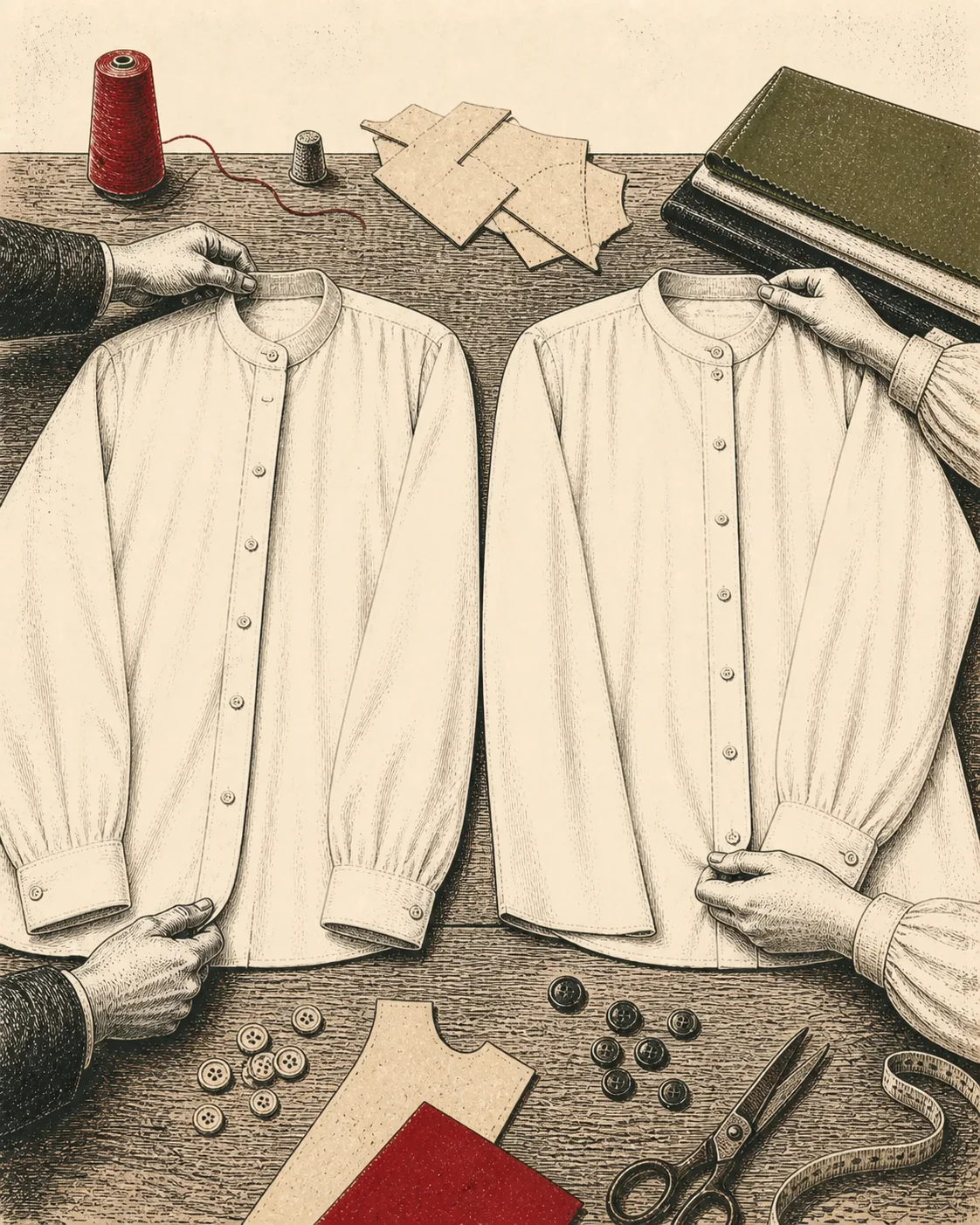
Button a men’s shirt and the fabric closes right side over left. Button a women’s shirt, cut from the same bolt in the same factory, and it closes left over right. Nobody designed this into either garment on purpose, not anymore. It survived from somewhere else, and the honest answer to where is that historians do not know.
That’s not a dodge. It’s the finding. A convention this consistent, worn by roughly half the species every day for over a century, ought to have a paper trail. It doesn’t. What exists instead is a set of stories, repeated with total confidence in places that should know better, none of them resting on a document anyone has produced.
The pattern is real before the explanation is
Start with what can actually be checked: the garments themselves. A survey of surviving women’s dresses, compiled through research reproduced at Maggie May Fashions, tracks button placement decade by decade. Buttons were uncommon on women’s clothing at all before the late eighteenth century; ties, hooks, and pins did the work instead. When buttons did appear, on jackets and riding habits called redingotes, they sat mostly on the right through the early 1800s. By the 1830s the sides were split about evenly. The 1850s tilt left. From the late 1860s on, the survey finds women’s buttons “all left.”
That is roughly seventy years of drift, not a single decision. Whatever set the convention, it was not one tailor’s ruling or one servant’s convenience solving itself overnight. It was a slow migration across a century of dressmaking, and it had already finished before most of the folklore claims to explain it were being told the way they’re told now.
The maid theory, and why a costume historian doesn’t buy it
The most repeated explanation goes like this: wealthy women were dressed by servants, the servant stood facing the woman rather than behind her, and a right-handed maid works more easily on buttons that sit, from her own perspective, on the right, which puts them on the woman’s left. Fashion faculty JuYoung Lee and Caroline Kobia repeat a version of it in a 2025 piece for The Conversation, noting that roughly 90 percent of people are right-handed and that men, who dressed themselves, kept buttons on their own dominant side.
It’s a tidy mechanism. It is also, according to the costume historian who has looked hardest at it, built on sand. Mary Miley, who writes the blog History Myths Debunked and has spent decades handling nineteenth-century women’s clothing, argued in a 2016 post that the maid story doesn’t survive contact with the evidence. She reports that curators of period garments “have seen buttons on both sides” well into the era the theory claims was already settled, and she flags the deeper problem directly:
“the argument about maids is illogical”
Her reasoning: by the time ready-made women’s clothing became common, in the early twentieth century, the women buying it off a rack were not the sort who employed a lady’s maid to dress them. The convention that supposedly exists to serve wealthy women with servants was, on her account, most likely fixed in place by mass manufacturing for women who had neither. Nobody she spoke to, including curators who work with the actual objects, would commit to a firmer answer. Her own conclusion is a shrug dressed as a sentence: the left-button standard probably solidified in the early 1900s, alongside industrial garment production, for reasons nobody wrote down at the time.
The theories that explain less than they claim to
The sword theory has a real mechanism behind it too. Writer Paul Keers argued in a 2011 piece that a man’s jacket buttoning right over left would snag the pommel of a sword drawn right-handed from the left hip, so tailoring shifted the opening the other way. It’s plausible on its own terms, and it has the virtue of being specific about cause and effect. What it doesn’t do is explain women’s buttons at all. A theory that only accounts for half the pattern isn’t an answer to the question this piece is asking.
Sidesaddle riding and nursing get offered almost interchangeably: women rode with their right side forward so a left-side opening would catch less wind, or women holding an infant in the left arm need the opening on the left for the right hand to work. History Facts, in a roundup of the competing claims, rates both “not particularly convincing,” and it’s easy to see why: neither theory is tied to a date, a document, or even a single named proponent earlier than the modern listicles repeating it. They sound like reasons because they involve real bodies doing real things. Sounding plausible is not the same as being traced.
Then there’s Napoleon. The story holds that women mimicked his famous hand-in-waistcoat pose to mock him, and he retaliated by ordering their buttons moved to the other side. Every outlet that has actually gone looking for where this claim originates comes back empty. History Facts calls it “almost certainly apocryphal.” Nobody has produced the decree, the tailor’s account, or a contemporary letter mentioning it. What the Napoleon story has, instead of evidence, is a good shape: a single powerful man, a single vain reason, a single day it supposedly happened. That shape is exactly why it survives. Real cultural drift, the kind the actual button survey documents, took seventy years and no named villain. Nobody retells that story at a dinner party.
What actually explains why nobody fixed it
The most defensible statement in the entire record came from journalist Benjamin Radford in 2010, and it isn’t an origin story at all. It’s an observation about inertia:
“There’s no real reason the buttons couldn’t be switched. It’s just that nobody has bothered to change a tradition.”
That single sentence survives scrutiny better than any of the origin myths, because it doesn’t claim to explain the beginning. It only explains the middle: once a manufacturing standard exists, changing it costs money and coordination for a return nobody is asking for. Lee and Kobia make the same point from the other direction. When zippers replaced buttons in the early twentieth century, manufacturers didn’t reconsider which side the closure belonged on. They copied whatever side the buttons had already settled on and moved the machinery over. The convention didn’t survive because it was right. It survived because switching it required someone to care enough to spend money proving a point nobody was making.
How the myths got made
Line up the explanations and a pattern shows up that has nothing to do with buttons. The maid theory has a mechanism but no primary source, and the one historian who checked it closely calls it circular. The sword theory has a mechanism and a named proponent but explains only one side of the garment industry, not both. The sidesaddle and nursing theories have neither a source nor a date. The Napoleon theory has neither evidence nor plausibility, only a memorable villain, and that’s precisely why it’s the version that keeps getting retold on social feeds a century after anyone can trace it.
Every one of these stories does the same job: it turns seventy years of uncoordinated dressmaking decisions into a single scene with a cause. That’s what folklore is for. It’s satisfying in a way that “the pattern drifted over several decades of nineteenth-century tailoring for reasons nobody recorded” will never be. The honest version of this story has a shape too, just a less flattering one: a convention set by accident, defended by nobody, and explained after the fact by whoever told the best story next.