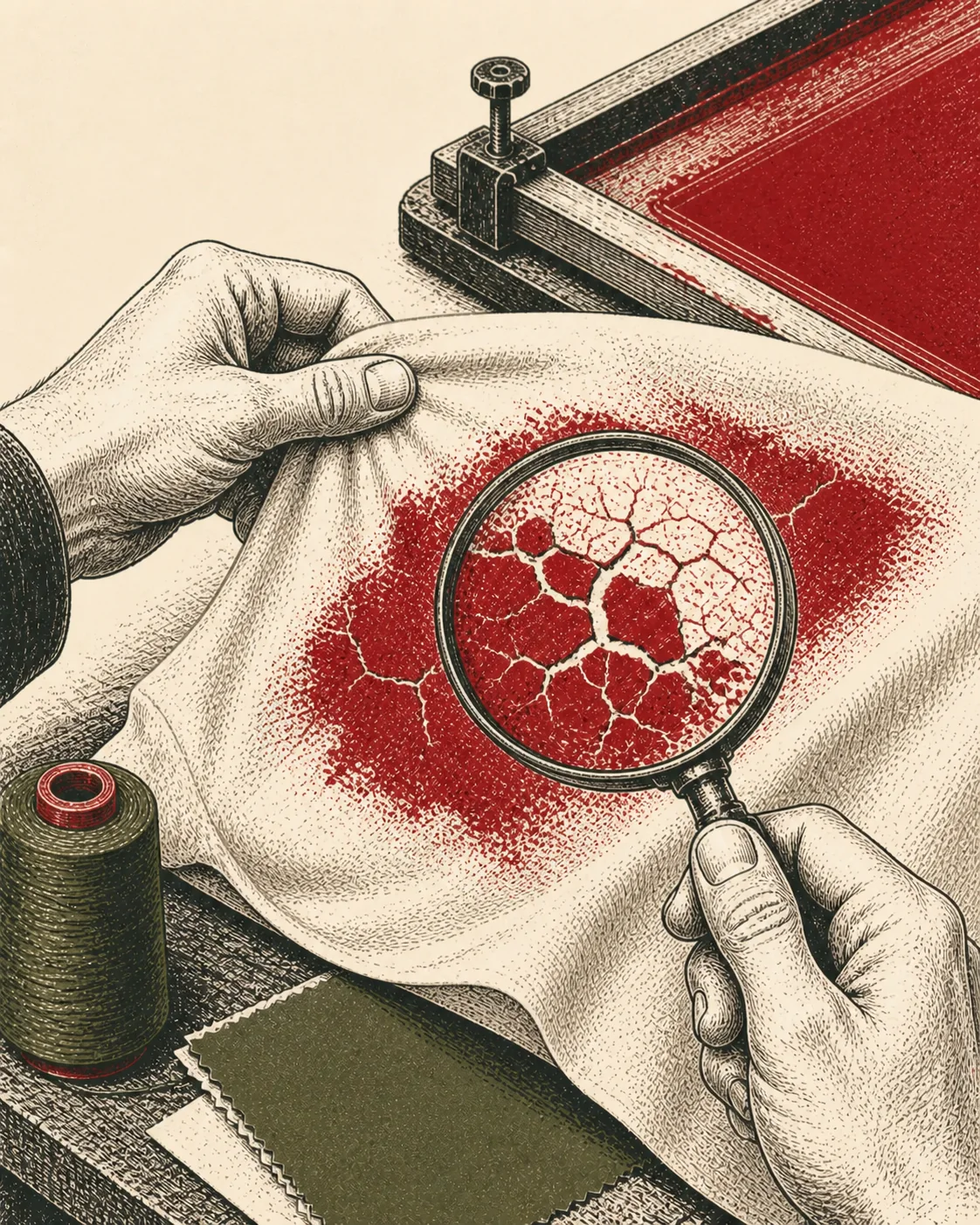
A screen print cracks for one structural reason: the cured ink is stiffer than the fabric moving underneath it. Cotton jersey stretches every time an arm goes overhead or a shirt gets pulled over a shoulder. A properly cured plastisol film stretches with it, because the cure leaves enough plasticizer in the ink to keep it flexible. A poorly cured film does not, and stretch finds the weakest line in that brittle plastic and splits it. Everything else in this piece, the cure temperature, the ink deposit, the dryer, is a variable that decides which side of that line a given print lands on.
What curing actually does to the ink
Plastisol arrives at the printer as a liquid PVC resin suspended in plasticizer, essentially uncured until heat is applied. It needs to reach roughly 320°F (160°C) through the full thickness of the ink film, not just at the surface, according to the manufacturer guidance at Plastisol Ink. Printers flash-cure a base layer at a lower 280 to 300°F just to gel it enough to print a second color on top, then run the whole shirt through a conveyor dryer for the real cure. Heat-sensitive synthetics sometimes use low-cure inks formulated to fully gel closer to 270°F so the dryer never scorches the fabric.
The catch is that a shirt can come off the dryer looking perfectly cured and not be. SanMar University’s decorator guidance puts it plainly: an undercured print “likely will pass a stretch test” fresh off the line, and the failure shows up later, as cracking or dye migration once it’s been washed. The ink deposit hasn’t fully bonded to the fabric or to itself, and it takes a few trips through a washer and dryer, flexing and relaxing over and over, before the weak spot gives out. That delay is exactly why undercure is easy for a printer to miss and easy for a customer to blame on something else.
Overcure fails the same way, on a different clock
Push the same ink past its cure window and the opposite problem shows up on the same delayed timer. Overcured plastisol bakes out too much of its plasticizer and the film turns brittle instead of pliable. According to the same SanMar guidance, an overcured print typically looks fine at first and only starts to crack and fade prematurely after several washes. Undercure and overcure are opposite mistakes, too little heat and too much, but they produce close to the same customer complaint months apart: a shirt that looked fine at checkout and started splitting along the print edges after a season of normal washing.
Ink deposit and fabric play a role too. Lawson Screen & Digital Products’ plastisol troubleshooting guide identifies thick, undercured ink deposits as the most common cause of cracking, since a heavy layer takes longer to cure all the way through and is more likely to get pulled off the dryer before it does. Fabric matters on the other side of the equation: a low-GSM knit stretches further than a heavier jersey under the same pull, and Lawson’s guidance notes that stretch can outrun what even a well-cured ink film can absorb. Cheaper plastisol compounds the risk further, since budget-grade ink is often formulated with less plasticizer to begin with, leaving less margin before the film turns brittle.
Why printers get the cure wrong in the first place
Curing sounds like a simple instruction, set the dryer to 320°F and run the shirt through, but a conveyor dryer heats the surface of the ink faster than it heats the ink underneath. A design with a heavy deposit, several layers stacked for opacity on a dark shirt, or a wide solid block of color, can read as hot enough at the surface while the ink two layers down never crosses the cure threshold. That’s the scenario Lawson Screen & Digital Products points to when it names thick, undercured deposits as the most common cause of cracking: the operator trusts a surface temperature reading or a fixed dwell time on the conveyor, and a design that happens to be thicker than the last job on that same belt speed comes out looking cured without being cured all the way through. A white or light underbase printed under a bright color on dark fabric adds exactly this kind of extra layer, which is one reason a heavily underbased print on a dark tee is more failure-prone than the same graphic printed directly on a light shirt.
None of this is visible at the counter. A correctly cured print and an undercured one look identical under store lighting, and both pass the fold-and-stretch test a buyer might try before paying. The difference only shows up after the fabric and the ink have been through several real wash-and-dry cycles together, which is exactly the gap between when a shop decides a batch shipped fine and when a customer decides the shirt was cheaply made. It’s also why a printer’s reputation matters more than any single garment’s first impression: consistent, correctly calibrated curing across every run is an operational discipline, not a property of any one shirt off the line.
What the dryer at home actually contributes
None of this is your dryer’s fault in the way people assume. A residential dryer’s high heat setting runs around 140 to 150°F, well under plastisol’s roughly 320°F cure point, so a home dryer cannot cure or overcure ink no matter how hot the setting runs. What a hot dryer does is put a print through hundreds of tumble cycles at heat, and it drives shrinkage in the cotton underneath it. The U.S. Department of Agriculture’s Southern Regional Research Center found in 1999 that cotton fabric dried repeatedly at high heat develops cracks in the fiber itself and can lose 25 percent or more of its strength. A print riding on top of fabric that’s shrinking and weakening around it is under more stress with every cycle, and a marginal print, one sitting close to its own cracking threshold from the day it was made, is the one that finally opens up. That’s the mechanism behind the advice on every DRESS care tag: wash cold, hang dry, because the fabric and the ink both last longer without repeated high heat asking questions of a bond that was only ever rated to handle so much.
A print that survives its first two years of ordinary washing was cured correctly the first time. Everything after that is the shirt doing what cotton and cured plastisol are supposed to do together, which is move.