A collar goes slack years before the shirt does. The body fabric is still sound, the print is still holding, and the neckline has turned into a loose loop that won’t sit flat against the collarbone anymore. People call this normal wear. It isn’t, not entirely. A collar stretching out faster than everything around it is a specific mechanical failure, and it happens at three points that are visible on a spec sheet before you ever buy the shirt.
The collar is not the shirt’s fabric
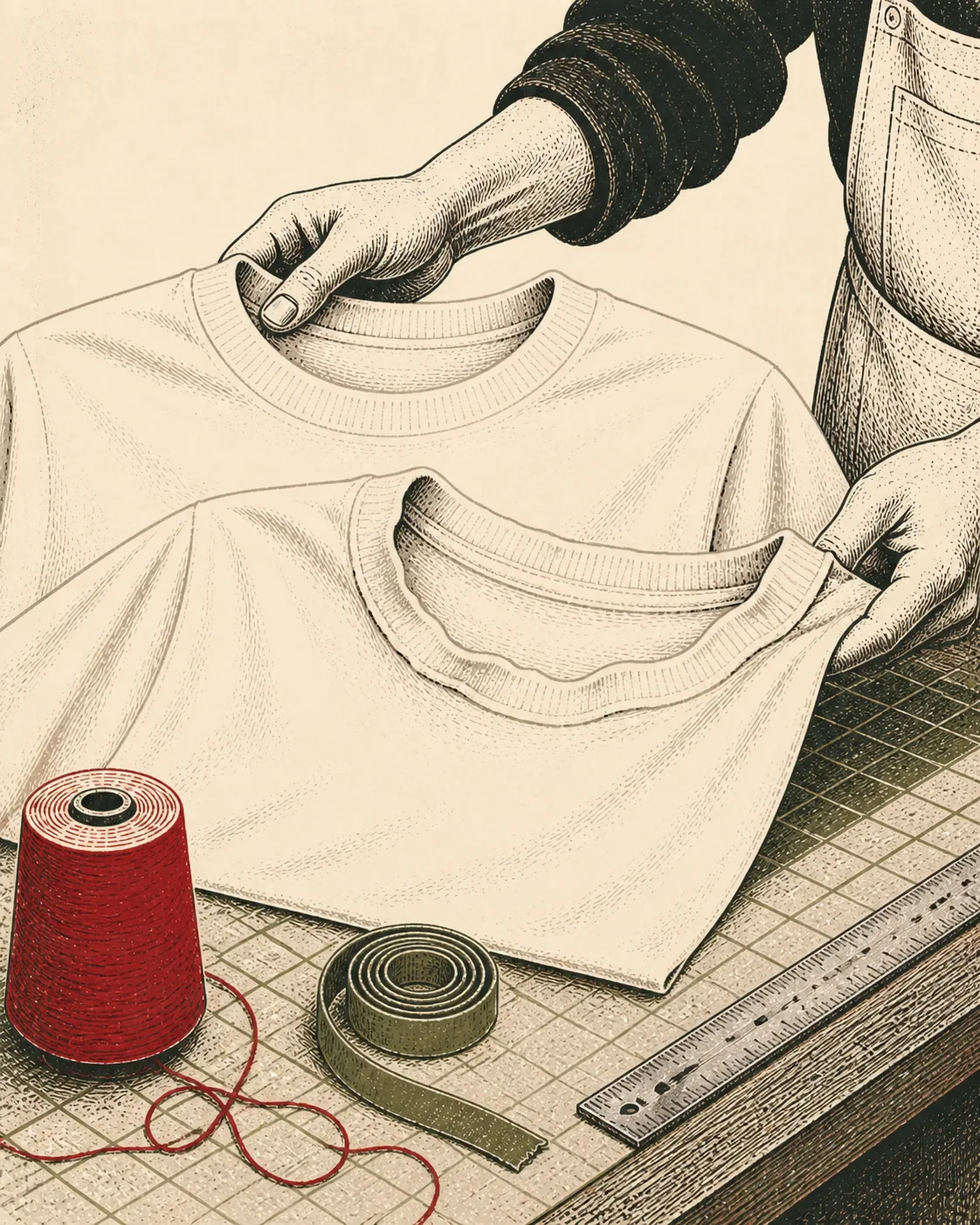
The ribbed band around a crew neck is a second piece of knit, cut separately from the body and sewn on smaller than the neckline hole it covers, so it sits under tension and hugs the neck instead of gaping. That rib is knit differently than the jersey it’s attached to. Ordinary t-shirt jersey is a single-knit structure, one continuous face. Rib knit alternates columns of knit stitches and purl stitches, which is what lets it stretch wide to go over a head and then pull back in. The most common version on a tee collar is called 1x1, meaning one knit column, one purl column, repeating. Heavier garments, and some tee collars aiming for a chunkier look, use 2x2, two columns of each. The wider bands in 2x2 make a thicker, more textured trim with more visible structure, according to the technical comparison published by Rib-Knit.com. The tighter alternation in 1x1 is what gives it the snappier recovery that a t-shirt collar needs, which is why 1x1 remains the standard trim for lightweight collars and 2x2 shows up more on sweaters and heavier cuffs, a distinction Jinxi Textile’s technical materials on collar and cuff rib draw the same way. Buy a rib knit collar built the wrong way for the garment and it was never going to hold its shape, no matter how carefully you wash it.
The tape you can’t see is doing the structural work
Rib alone doesn’t stop a neckline from stretching. Underneath it, sewn into the inside of the seam, sits a strip of tape running from one shoulder seam across the back of the neck to the other, called shoulder-to-shoulder taping. Its job, as the apparel decoration glossary at Show Your Logo describes it, is to stabilize that seam so the shoulders and collar don’t give way under the shirt’s own weight or the daily pull of putting it on over a head. TextileGlossary.com describes the same tape in more general terms: a reinforcing strip stitched along a neckline specifically to prevent stretching and sagging over time. A blank that skips the tape, or runs it only across the back without reaching the shoulder seams, has nothing holding that seam rigid, so the rib has to do all the resisting on its own and eventually loses.
The material of the tape matters too. Spec sheets sometimes call for self-fabric tape, meaning the tape is cut from the same knit as the shirt body rather than a separate material, a term with a plain meaning: a self-fabric piece is one made from the garment’s own fabric rather than a contrasting one. Self-fabric tape moves and washes at the same rate as the shirt around it, so it doesn’t pucker or pull loose as the garment shrinks or stretches with wear. A mismatched tape, stiffer or looser than the body fabric, works against the seam instead of with it.
What stitch is actually holding the collar down
Taping and rib recovery only matter if the stitching holding them in place stays put. The collar seam on most tees is sewn with a double-needle coverstitch, two parallel lines of stitching laid down at once, rather than a single line. Two rows spread the load across more stitches, so the seam is less likely to pop a single point of failure and pull the fold of the collar with it. A single-needle seam is not automatically inferior, and some higher-end shirtmaking still favors it for a flatter finish elsewhere on a garment, but at a stress point that gets pulled over a head thousands of times, the second row of stitching is doing real work. The Bayside 2905, a union-made 6.1 oz blank, lists both features together on its own spec sheet: shoulder-to-shoulder taping and double-needle stitching, the two named as separate, deliberate construction choices rather than one implying the other.
None of the three features cost much on their own. A second needle, a longer strip of tape, a rib knit at the right ratio: none of it is exotic material or slow handwork. What it costs is attention during pattern making and cutting, since the tape has to be cut to the right length to actually reach both shoulder seams instead of stopping short across the back, and the rib has to be cut to a size that puts real tension on the neckline instead of just filling the hole. A spec sheet either lists these features by name or it doesn’t, and a shirt with the features named tends to have been checked for them on the cutting table too.
What actually stretches a collar in the closet
Given a collar built correctly, the fastest way to ruin it afterward is a thin wire hanger through the neck hole. Gravity pulls the weight of the whole wet or dry shirt down through that one narrow band, every day it hangs there, and rib recovers less completely each time it’s stretched under sustained load rather than a quick pull-on and pull-off. A hot dryer compounds the same problem from a different direction: heat relaxes a rib’s elastic recovery over repeated cycles, so a collar that would have snapped back after air drying stays a little looser each time it goes through a hot cycle. Neither of these will stretch a well-built collar out in one wear. Both will, over a few years, on any collar, well built or not.
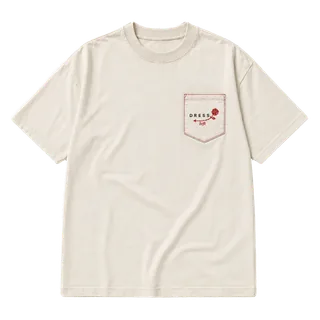
None of this makes a stretched collar reversible after the fact in most cases. A rib that’s gone soft from heat and repeated hanging can sometimes tighten partway back with a hot soak and a hot dryer cycle, since heat is what relaxed it and heat can shrink it some of the way back. Once the yarn itself has broken down, or the tape has actually separated from the seam, nothing done at home restores it. The real fix happens before the shirt is bought, on the spec sheet: a 1x1 rib collar, shoulder-to-shoulder tape, and a double-needle coverstitch holding both down. The DRESS logo tee is built on a union-made 6.1 oz blank with that taping and stitching specified, which is one reason the collar is the last thing to go, not the first.
Fold it instead of hanging it by the neck, and it will outlast the rest of the shirt’s excuses.