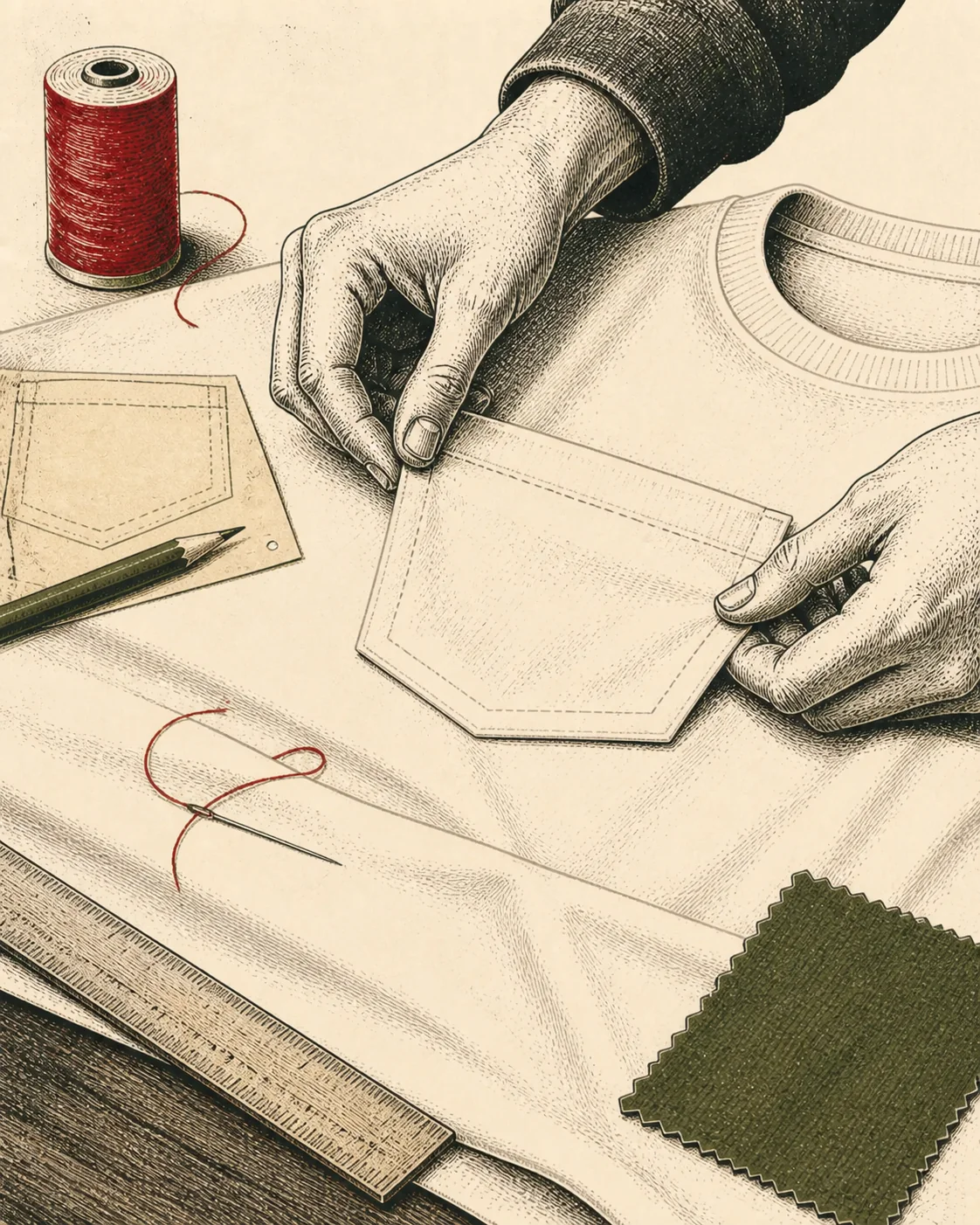
On August 16, 1929, a man named John W. Champion walked into the patent office with a problem that had nothing to do with fashion. Champion worked with Reliance Manufacturing Company of Chicago, and the shirts his company sold had a flaw: a worker who tucked a pack of cigarettes into the chest pocket of his shirt would, by the end of a shift, find the pack ruined. A single layer of cotton was no barrier to sweat. The paper softened, the pack came apart, and a day’s cigarettes were lost to a man’s own body heat.
Champion’s fix was not clever in the way people mean when they praise cleverness. It was a second layer of fabric behind the first, with an air gap between them, so the cigarettes sat away from the body instead of against it. The bottom of that inner layer stayed unsewn on purpose, left open so air could move through and carry the moisture away rather than trap it. The patent, granted June 17, 1930 as US 1,763,688, describes the whole mechanism in a single sentence: fabric “folded to form upwardly extending front and rear walls with the bottom therebetween,” sewn at the sides, open at the base. That is the ancestor of every chest pocket that followed it, including the one stitched onto a cotton tee sixty years later.
The pocket came from the work shirt, not the t-shirt
The t-shirt itself predates Champion’s patent by sixteen years. The U.S. Navy made the crew-neck white cotton undershirt standard issue in 1913, and for the next few decades it stayed exactly that: an undershirt, worn under a uniform, not seen. Champion’s pocket, meanwhile, went onto woven work shirts, the kind a man wore as his outer layer on a factory floor or a loading dock. Reliance built the pocket in pairs on some of its shirts: a smaller cigarette pocket, sized to a standard pack, next to a larger open pocket that held loose tobacco, rolling papers, or a pencil.
Pocket placement wasn’t fixed either. On 1930s work shirts the pocket typically lined up with the third button of the front placket, or fell a little below it, depending on the maker. Over the following decades that position drifted higher, so that a modern shirt pocket usually sits closer to the second button. Nobody standardized this on purpose. Pattern makers nudged it a little with each generation of shirts, and the drift only shows up when you lay a 1930s work shirt next to one cut today.
The two garments didn’t merge until after the war. Soldiers who’d worn t-shirts as undergarments came home with the habit of stripping down to them in the heat, and by the early 1950s the t-shirt had become something a man could wear alone in public without anyone reading it as underwear. The pocket rode along with that shift because the men doing manual work already expected a shirt to carry something. No dated patent or trade catalog fixes the year a pocket first landed on a t-shirt specifically rather than a work shirt, so the honest claim is a decade, not a date: by the 1950s, pocket tees existed as their own category, descended from a pocket built fifteen years earlier to keep cigarettes dry.
What a chest pocket does to the panel it sits on
A patch pocket is not decoration laid on top of a shirt front. It changes what that part of the shirt is. Where the pocket sits, the wearer is looking at two layers of fabric instead of one, sewn down on three sides with the fourth left as an opening. That second layer adds body to a spot on the shirt that would otherwise move exactly like the rest of the jersey around it: it resists stretch, it holds its shape when something sits inside it, and it reads, visually, as the densest part of the garment even before anything is printed there.
That is also why a pocket is one of the first places a cheap knit shirt fails. The corners take the most stress, every time a hand goes in or out, so a pocket without reinforced stitching at those points is a pocket that will tear loose before the rest of the shirt shows wear. Champion’s original design sidestepped the problem by leaving the bottom open and unstressed. A pocket that is fully closed on all four sides, which is what most decorative t-shirt pockets are, has no such relief valve, so the stitching at the top corners is doing all the work every time the shirt is pulled over a head or thrown in a dryer.
Why the pocket survived after the cigarettes left
Cigarette packs got their own foil-lined boxes decades ago, and the sweat problem Champion solved stopped mattering to most of the people wearing his design. What outlived the problem was the shape. A chest pocket on a tee now signals “built like a work shirt” the way a rolled cuff signals “meant to be worked in,” whether or not anyone plans to put a pencil in it. Screen printers found a second use for it that had nothing to do with storage: the pocket is a small, flat, high-visibility panel sitting exactly where a logo reads best, on a shirt that would otherwise have nowhere obvious to put one.
That’s the version we build on. The Logo Tee carries the rose-and-arrow mark in miniature on a contrast-trim pocket, the two-color print sized to the same panel Champion sized for a pack of cigarettes. Nobody is putting cigarettes in it. The pocket earns its place on the shirt because a hundred years of work shirts taught everyone what that rectangle of doubled fabric is supposed to mean before a single word gets printed on it.