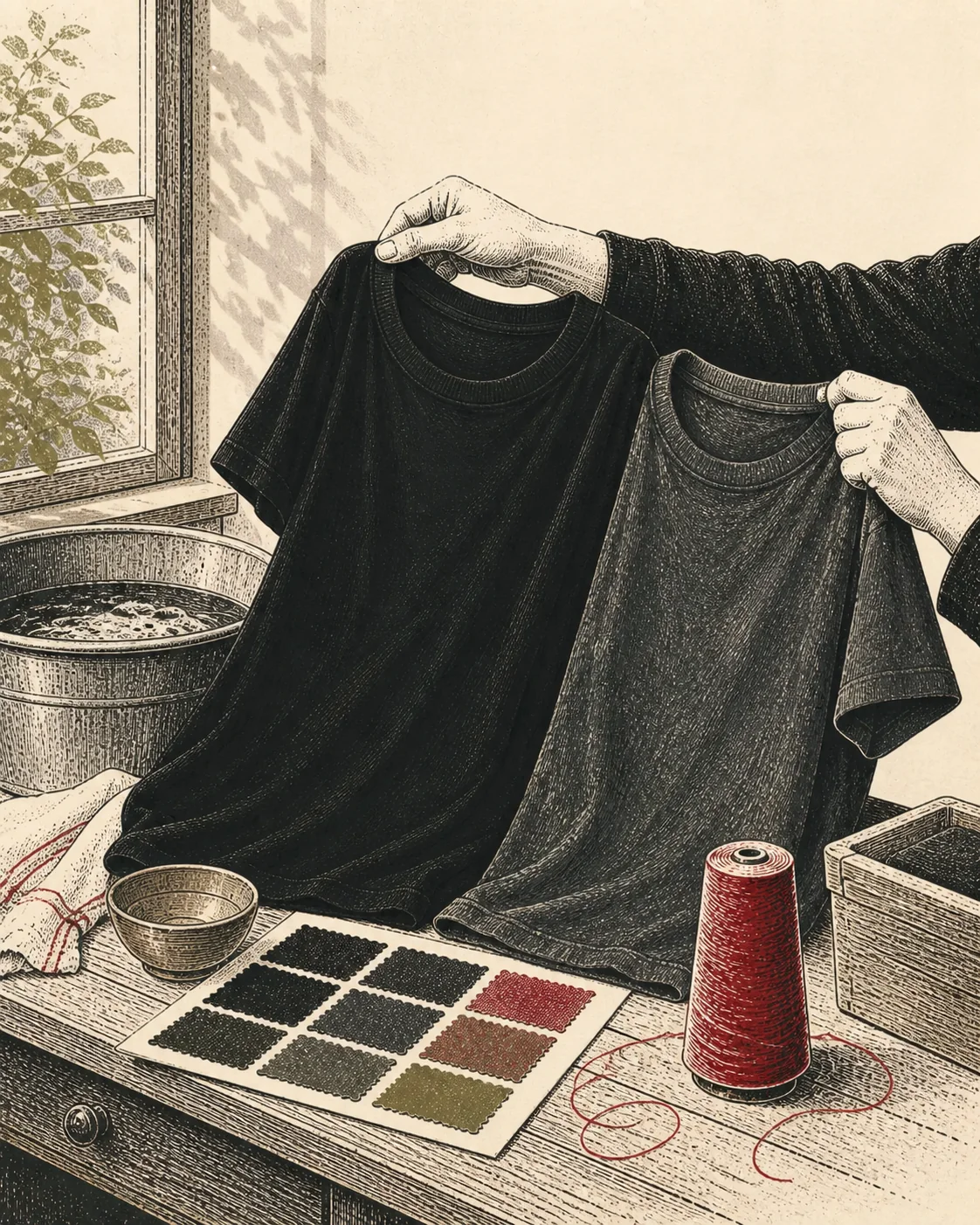
A black cotton tee comes out of the dryer a shade grayer than it went in, and the household explanation arrives fast: the detergent did it. Switch to a gentler detergent, wash in cold water, maybe skip the dryer, and the shirt keeps fading anyway, because detergent was never the main mechanism. Three separate things get called “fading,” they have different causes, and the one everybody blames is usually not the one doing the damage.
Three different failures, three different tests
Textile chemists do not lump fading into one problem, because a fabric can pass one fastness test and fail another. The American Association of Textile Chemists and Colorists publishes a separate test method for each failure mode. AATCC Test Method 61 measures colorfastness to laundering: an accelerated wash cycle with a standard detergent and steel balls for agitation, graded against a reference gray scale for how much the color shifted. AATCC Test Method 8 measures colorfastness to crocking: a weighted crockmeter arm rubs a white test cloth against the fabric, dry and then wet, and the transferred color is graded on the same gray scale. AATCC Test Method 16 measures colorfastness to light: a xenon-arc lamp simulates sunlight exposure over a set duration, and the fading is graded again.
A shirt can score well on the wash test and poorly on the crocking test. Those are not contradictory results. They are two different failure modes, and a black tee that grays out over a summer is far more likely to be failing the crocking mechanism than the laundering one.
All three tests grade the result the same way, against an AATCC gray scale for color change: a strip of paired gray chips running from grade 5, negligible or no change, to grade 1, a shift big enough that nobody would mistake the two chips for the same color. A lab technician holds the washed, rubbed, or light-exposed specimen next to the scale and matches it to the closest step. The grading tool is identical across all three procedures. What differs is what got done to the fabric before the grading, and a fabric can grade well on one of the three tests and poorly on another, because laundering chemistry, rubbing, and light exposure stress the color by different routes.
The dye is doing most of the deciding
Cotton takes color from several different dye chemistries, and they do not perform the same way once the shirt leaves the dye house. Fiber-reactive dyes form a covalent bond with the cellulose in the cotton fiber, which is why they carry the best wash and crock fastness of the common classes: the color is chemically attached, not just sitting in the fiber. Vat dyes get there by a more complicated route, reduced to a soluble form to penetrate the fiber, then oxidized back to an insoluble pigment once inside, and they land close to reactive dye in wash fastness at a higher production cost.
Sulfur dye is the outlier, and it is the one most likely to be on a black t-shirt. It is inexpensive, it produces strong light fastness in dark shades, and the cotton dyeing industry treats it as the standard choice for black precisely because darker colors hide its weaknesses in hue accuracy. Its known limitation is crock fastness: sulfur dye is more prone to rubbing off onto other surfaces than reactive or vat dye is. That is the same failure mode AATCC Test Method 8 was built to measure. A black shirt dyed with sulfur dye can hold its depth of color under a summer’s worth of sunlight and still lose visible pigment to a car seat, a backpack strap, or a washing machine drum, because light exposure and rubbing exposure are stressing two different bonds.
The chemistry explains why. A reactive dye molecule carries a group that forms an actual covalent bond with the cellulose chain, the same category of bond that holds the cotton fiber together in the first place; pulling that color out means breaking a bond, not just overcoming a weak attraction. Sulfur dye works differently: it is reduced to a soluble form to enter the fiber, then reoxidized inside it into an insoluble, largely physical deposit, closer to a pigment lodged in the fiber’s structure than a molecule chemically welded to it. That deposit sits where light cannot easily break it down, which is why the light-fastness numbers look good. It has nothing bonding it against a mechanical shove, which is why a crockmeter, and a washing machine, moves it.
Where the detergent argument breaks down
Detergent is not blameless, but its role is narrower than the household explanation gives it credit for. Enzyme detergents formulated to break down protein and starch stains can be harder on some dye classes over repeated washes, and optical brighteners made for whites will dull a dark garment by adding a bluish cast that reads as faded even when no pigment has actually left the fiber. Neither of those is the dominant mechanism for a black cotton tee losing its depth of color over a season of normal wear and washing.
The dominant mechanism is friction. A washing machine drum is a controlled abrasion device: the load tumbles against itself, against zippers, against buttons, for the length of the cycle, and every rotation rubs the dyed surface a little more. That mechanical wear is what AATCC 8 is measuring when it drags a crockmeter arm across a swatch, and it is functionally the same thing a wash cycle does at a larger scale and lower intensity, repeated dozens of times over a garment’s life. Detergent-for-darks marketing mostly buys you the absence of brighteners, not a fix for a dye class’s crock rating.
Part of what reads as fading is not color loss at all. Friction raises tiny broken fiber ends at the fabric surface, the same process that produces pilling on a well-worn knit. Those raised fibers scatter light instead of letting it hit a flat, dyed surface straight on, and a scattering surface looks paler and grayer even where the dye underneath is largely intact. That is one more reason a black shirt can look noticeably faded well before its measured color loss would explain the difference: the surface texture changed along with the color, and the eye reads both as one thing.
What actually slows it down
None of this makes fading unavoidable, it just points at the right lever. Washing a dark shirt inside out puts the less-exposed face of the fabric against the load instead of the face people look at, cutting the abrasion that reaches the visible surface without changing the dye’s underlying fastness. Washing with a smaller, less crowded load reduces the garment-on-garment friction that a full drum produces. A lower spin speed does the same for the final tumble that squeezes water, and abrasion, through the fabric. None of these change the chemistry; they reduce the number of times the dyed surface gets rubbed.
What DRESS does, specifically
DRESS garment-dyes its shirts: the finished, sewn garment goes into the dye bath rather than dyeing yarn or uncut fabric ahead of construction. That changes how deep the color sits and how the fabric hands feel from the first wear, and it is a separate question from which dye class colors a given shade. The Logo Tee’s washing guidance, cold water, inside out, hung dry, follows from both facts at once: garment dyeing means the surface color is still settling in the first several washes, and cotton in general loses less color to abrasion when it spends less time rubbing against the rest of the load.
A black shirt that grays out over a year did not fail because someone used the wrong detergent. It failed a crocking test it was never given a grade on, worn hundreds of times against denim, car upholstery, and itself in a washing machine drum, colored with a dye class that was picked for its price and its light fastness rather than its resistance to rubbing.